
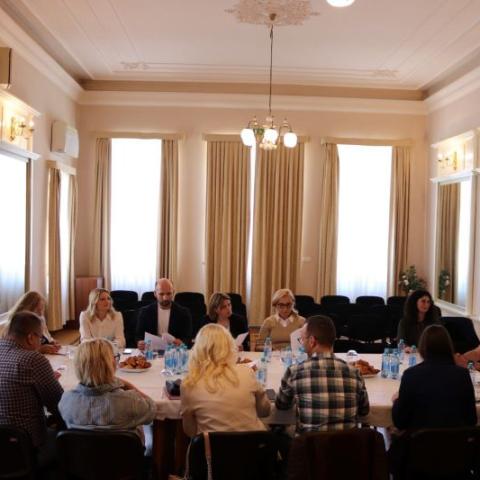
Toplice Lipik - Special Hospital for Medical Rehabilitation hosted the 2nd round table of the RE-TREAD project, which is implemented as part of the Interreg VI-A IPA Cross-Border Cooperation Program Croatia-Serbia.
On May 18, representatives of partner institutions from Croatia and Serbia gathered in Lipik Spa to exchange knowledge, experience and examples of good practice in the field of modern rehabilitation.
The central theme of the Round Table was "Multidisciplinary Approaches in Neurorehabilitation: The Combination of Specific Therapies, Robotics and Mobile Care for Patients". The participants discussed the application of DNS (Dynamic Neuromuscular Stabilization), the Schroth concept, the use of robotic systems for the rehabilitation of the upper limbs, the organization and work of mobile rehabilitation teams and exchanged experiences between partner hospitals.
New steps in rehabilitation
After the first round table held at the "Junaković" Special Rehabilitation Hospital in Apatin in October 2025, the meeting in Lipik represents an important step forward in the further improvement of professional cooperation and the development of innovative rehabilitation models. The conclusions and shared experiences from this meeting will additionally contribute to the improvement of protocols in partner hospitals and to strengthening the quality of care for patients for whom rehabilitation is a key part of recovery. Based on the exchange of common experiences, one of the key outcomes of this round table is the upgrade of the existing unique comparative study, which will enable a more precise and effective application of therapeutic protocols for the benefit of patients from the cross-border area.
At the gathering, representatives of partner hospitals shared their professional experiences and insights, among them dr. Ivan Pavao Čevizović from Toplice Lipik, prof. Ph.D. Ksenija Bošković from the Special Hospital for Rheumatic Diseases Novi Sad and Dijana Vračar, head nurse from the Special Hospital for Rehabilitation "Junaković" Apatin. Their participation additionally confirmed that quality rehabilitation today rests on multidisciplinarity, cooperation and readiness for constant acquisition of new knowledge.
Multidisciplinary approaches and innovative therapies in the service of a healthier and more active life
Along with the improvement of professional protocols for hydrotherapy, the work of mobile teams and rehabilitation procedures for the implementation of therapy with a robotic system for the rehabilitation of the upper extremities, the participants also emphasized the broader social importance of the project, especially in the context of promoting healthy and active lifestyles. Application of modern therapeutic methods, including robotics and organized work of mobile rehabilitation teams, is aimed not only at recovery, but also at empowering patients for a higher level of independence, regular physical activity and long-term preservation of functional abilities. Such an approach directly contributes to raising the quality of life and reducing the risk of further health complications. Through the RE-TREAD project, new multidisciplinary approaches and innovative therapies were introduced that go beyond the framework of traditional medical rehabilitation. Thus, the RE-TREAD project became an important platform for the promotion of a healthy, safe and sustainable way of life in the cross-border area of Croatia and Serbia.
In this context, PANORA - Development Agency of Požega-Slavonska County plays a special role, which participates in the project as a partner in charge of information and promotion activities, thereby contributing to the strengthening of awareness of the importance of modern rehabilitation approaches and cross-border cooperation in the field of healthcare. Special emphasis is placed on bringing the benefits of the project closer to the end users - patients, but also to the wider community, which further encourages the understanding and acceptance of innovative models of care and the development of healthy lifestyle habits.